Reproduction: How Life Continues · Lesson 7 of 12
Reproduction in Human Beings
“The human reproductive system is teamwork with extremely specialised team members.”
• Explain reproductive maturity during adolescence. • Identify the parts and functions of the male reproductive system. • Trace the route followed by sperm. • Identify the parts and functions of the female reproductive system. • Relate reproductive organs to gamete production and development.
As a child grows into an adult, the body changes gradually. Reproductive organs mature, hormones influence physical development and gamete production begins. These biological changes make reproduction possible, but they occur alongside continuing emotional and social development.
Reproductive maturity
Reproductive maturity develops during adolescence. Testes begin producing sperm, ovaries begin releasing mature eggs in cycles and hormones bring about characteristic changes of puberty. Maturity is a process rather than a single instant, and individuals do not all develop at exactly the same age or rate.
Human reproduction involves specialised organs. A sperm may meet an egg inside the female reproductive tract. Their fusion forms a zygote, which divides, becomes an embryo and later a foetus developing in the uterus.
What are the parts of the male reproductive system?
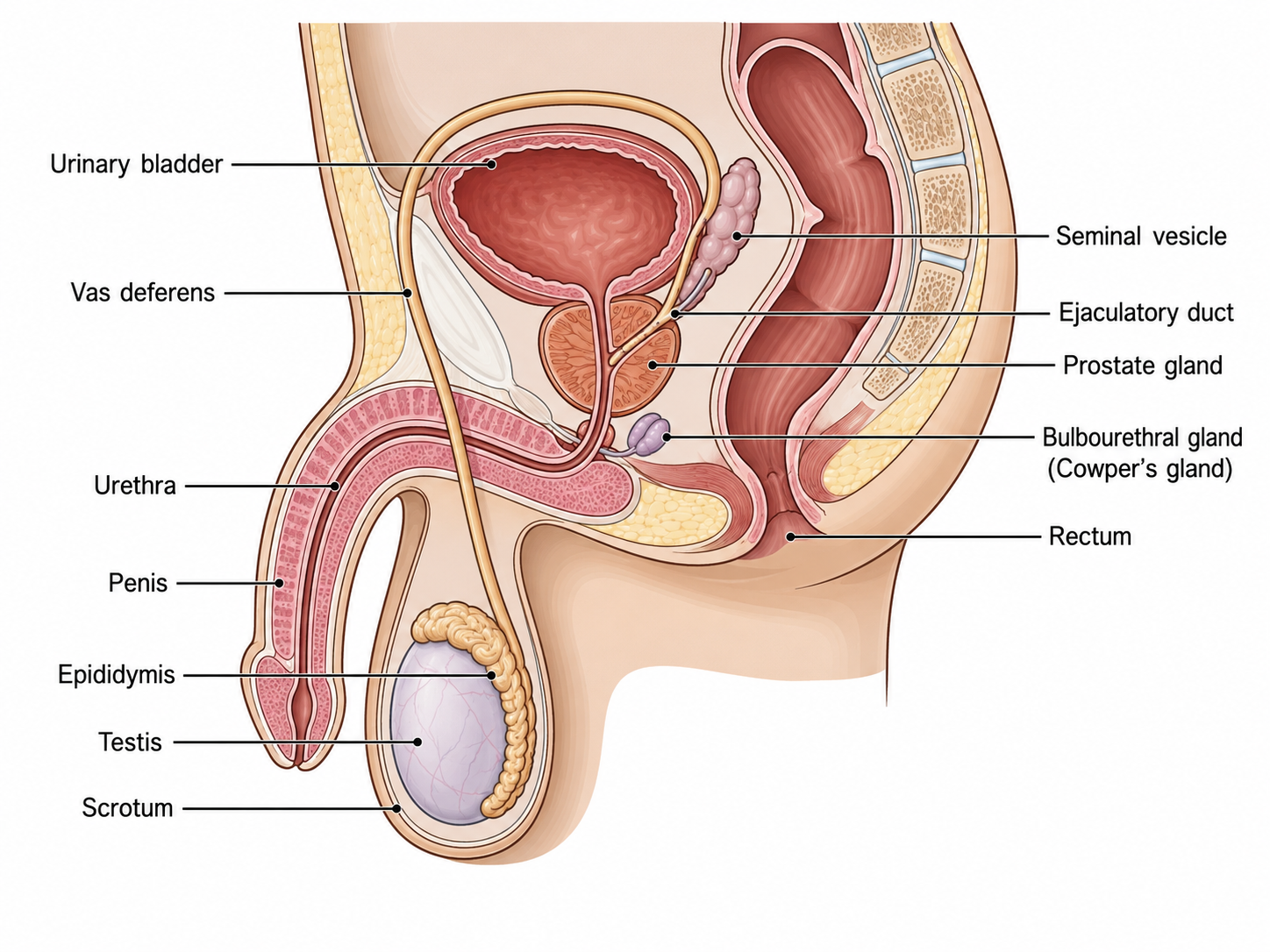
The testes are two oval organs that produce sperm. They lie in a pouch of skin called the scrotum. The scrotum keeps them slightly cooler than normal body temperature, a condition needed for sperm formation. The testes also produce a hormone that regulates sperm production and contributes to changes during puberty.
Sperm leave a testis through a long tube called the vas deferens. The tube eventually opens into the urethra. The urethra is a common passage for urine and sperm, although the two are not normally released at the same time. Seminal vesicles and the prostate add fluids that nourish sperm and support their activity and movement.
A sperm has a head containing genetic material and a long tail that helps it move towards an egg. Its small size and motility suit the task of travelling through the reproductive tract.
Problem
Trace the route and support received by a sperm after it is produced.
- 1.The sperm is produced in a testis.
- 2.It travels through the vas deferens.
- 3.Fluids from glands such as the seminal vesicles and prostate are added.
- 4.The mixture enters the urethra.
- 5.The sperm can then be transferred out of the male body.
What are the parts of the female reproductive system?
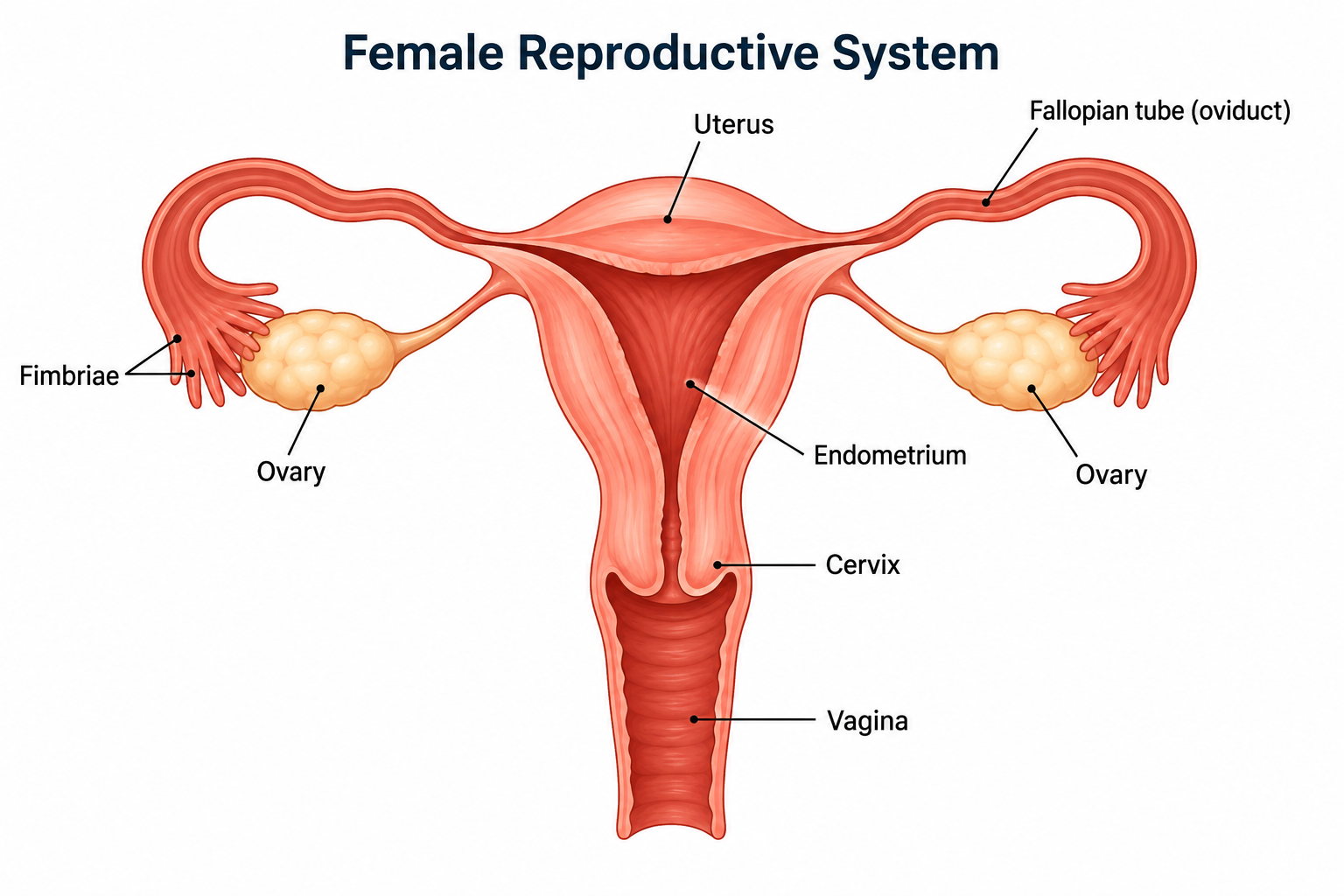
The ovaries form a pair and produce eggs as well as hormones involved in puberty and reproductive cycles. Each ovary connects towards the uterus through an oviduct, also called a fallopian tube. An egg released from an ovary enters an oviduct.
The uterus is a muscular, bag-like organ where an embryo and foetus can develop. Its lower narrow region, the cervix, opens into the vagina. The vagina forms the passage connecting the uterus with the outside of the body and later serves as the birth canal.
| Structure | Main function |
|---|---|
| Testes | Produce sperm and a reproductive hormone |
| Scrotum | Keeps testes slightly cooler than body temperature |
| Vas deferens | Carries sperm from the testes |
| Seminal vesicles and prostate | Add fluids that nourish and support sperm |
| Urethra | Passage through which sperm leaves the body |
| Ovaries | Produce eggs and hormones |
| Oviducts | Carry the released egg; usual site where sperm may meet egg |
| Uterus | Supports implantation and development |
| Cervix | Narrow opening between uterus and vagina |
| Vagina | Connects the reproductive tract with the outside |
The testes produce sperm and a reproductive hormone. The seminal vesicles and prostate mainly add supportive fluids; they do not produce sperm.
Quiz
Which statement is a key takeaway from this lesson?
Which additional statement is also a key takeaway from this lesson?
Which further statement is also a key takeaway from this lesson?
Which another statement is also a key takeaway from this lesson?
Which final statement is also a key takeaway from this lesson?
Practice Problems
- What changes make the body reproductively mature?
- Why are testes located in the scrotum?
- Trace the path of sperm from production to the urethra.
- What do the seminal vesicles and prostate contribute?
- Trace the route of an egg from an ovary towards the uterus.
- Distinguish the uterus, cervix and vagina by location and function.
- Where does a human foetus develop?
Key Takeaways
• Reproductive maturity develops gradually during adolescence. • Testes produce sperm, while ovaries produce eggs. • The vas deferens carries sperm and reproductive glands add supportive fluid. • Oviducts connect the ovarian region with the uterus. • The uterus supports development of the embryo and foetus.