The World of Numbers · NCERT Solved Problems
Exercise 3.EOC
End-of-Chapter Exercises
16 problems
- Convert the following rational numbers into a terminating decimal or a non-terminating repeating decimal, whichever the case may be, by the process of long division:
- (i)3/50
- (ii)2/9
- Prove that √5 is an irrational number.
- Convert the following decimal numbers into the form p/q:
- (i)12.6̅
- (ii)0.0120
- (iii)3.05̅2̅
- (iv)1.2̅3̅5̅
- (v)0.2̅3̅
- (vi)2.05̅
- (vii)2.125̅
- (viii)3.125̅
- (ix)2.1̅6̅2̅5̅
- Locate the following rational numbers on the number line:
- (i)0.532
- (ii)1.15̅
- Find 6 rational numbers between 3 and 4.
- Find 5 rational numbers between 2/5 and 3/5.
- Find 5 rational numbers between 1/6 and 2/5.
- If x/3 + x/5 = 16/15, find the rational number x.
- Let a and b be two non-zero rational numbers such that a + 1/b = 0. Without assigning any numerical values, determine whether ab is positive or negative. Justify your answer.
- A rational number has a terminating decimal expansion whose last non-zero digit occurs in the 4th decimal place. Show that such a number can be written in the form p/10⁴, where p is an integer not divisible by 10. Is it necessary that the denominator of this rational number, when written in lowest form, is divisible by 2⁴ or 5⁴? Give reasons.
- Without performing division, determine whether the decimal expansion of 18/125 is terminating or non-terminating. If it terminates, state the number of decimal places.
- A rational number in its lowest form has denominator 2³ × 5. How many decimal places will its decimal expansion have? Explain your answer.
- Let a = 7/12 and b = 5/6. Express both a and b in the form k₁/m and k₂/m where k₁, k₂ and m are integers and k₂ − k₁ > 6. Using the same denominator m, write exactly five distinct rational numbers lying between a and b keeping an integer numerator. Explain why the condition k₂ − k₁ > n + 1 is necessary to find n such rational numbers between the two rational numbers a and b using this method.
- Three rational numbers x, y, z satisfy x + y + z = 0 and xy + yz + zx = 0. Show that all the rational numbers x, y, z must be simultaneously zero.
- Show that the rational number (a + b)/2 lies between the rational numbers a and b.
- Find the lengths of the hypotenuses of all the right triangles in Fig. 3.14, which is referred to as the square root spiral.
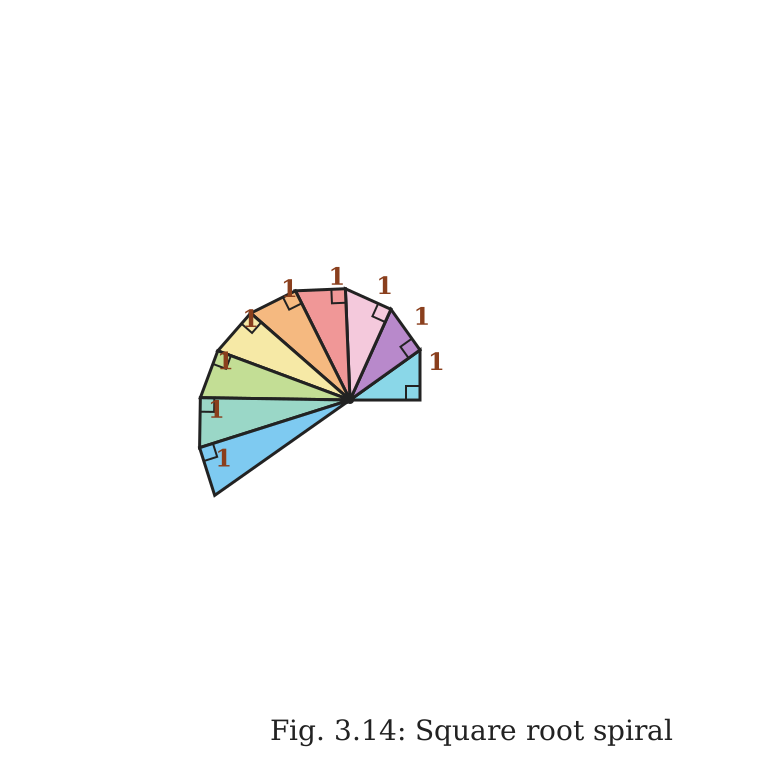
Fig. 3.14