Measuring Space: Perimeter and Area · NCERT Solved Problems
Exercise 6.EOC
End-of-Chapter Exercises — use π ≈ 22/7 unless stated otherwise
27 problems
- Identities in algebra can sometimes be shown as area relationships. For example: a b a a² ab The figure shown corresponds to the identity (a + b)² = a² + 2ab + b². Do you see how? b ab b² Fig. 6.41: Area model of an identity Draw figures corresponding to the identities (a + b)(a – b) = a² – b² and (a + b + c)² = a² + b² + c² + 2ab + 2bc + 2ca.
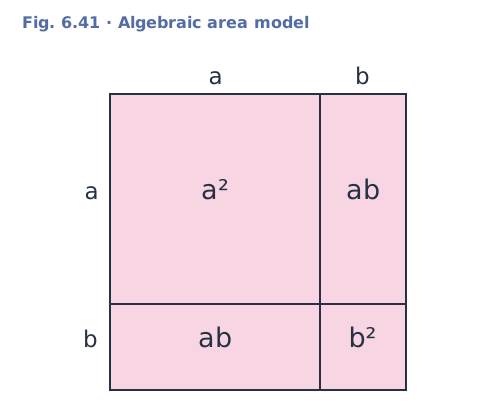
Fig. 6.41 - An isosceles triangle has perimeter 40 cm; the equal sides are 15 cm each. Find the area of the triangle.
- An isosceles triangle has base 10 cm, and its area is 60 cm². What are the lengths of the equal sides?
- The area of a right-angled triangle is 54 sq. cm. One of its legs has length 12 cm. Find its perimeter.
- The sides of a triangle are in the ratio 2: 3: 4, and its perimeter is 45 cm. Find its area.
- The sides of a triangle have lengths 7 cm, 24 cm, 25 cm. Find the area of the triangle in two different ways.
- If the wheel of a bicycle has a diameter of 60 cm, find how far a cyclist will have travelled after the wheel has rotated 100 times.
- Find the area of a quadrant of a circle whose circumference is 66 cm.
- The wheel of a car has an outer radius of 28 cm. Calculate how far the car travels after one complete turn of the wheel, and how many times the wheel turns during a journey of 1 km.
- Two rectangles have the same area and the same perimeter. Does this mean that they are congruent to each other?
- You know that the area of a parallelogram is base × height. Using Fig. 6.42, show that the area of a trapezium is half the sum of the parallel sides × height, i.e., (1/2)(a + b)h.
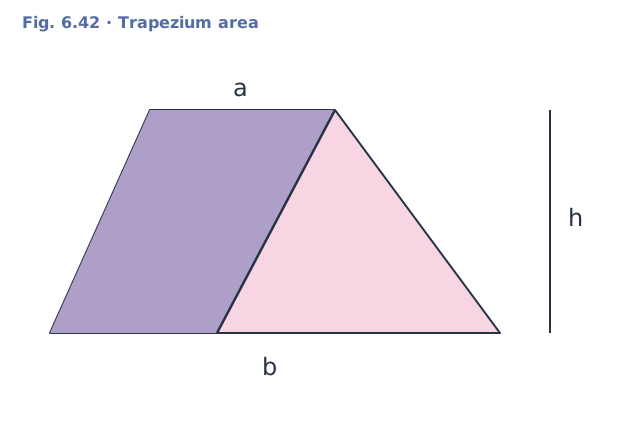
Fig. 6.42 - By dividing a trapezium into two triangles show that its area is, half the sum of the parallel sides multiplied by the height (the same formula as the one given above).
- Show how we can use two identical copies of a trapezium to make a parallelogram. How will this give us the formula for the area of a trapezium?
- Show that the area of a kite is half the product of its diagonals. Show this:
- (i)using algebra, and
- (ii)using geometry.
- Three problems about fitting congruent shapes together:
- (i)Rectangle ABCD has sides a, b, and rectangle PQRS has sides 2a, 2b. Show that PQRS has 4 times the area of ABCD. Does this mean that 4 copies of rectangle ABCD will fit into rectangle PQRS? Check and see!
- (ii)∆ABC has sides a, b, c, and ∆PQR has sides 2a, 2b, 2c. Show that ∆PQR has 4 times the area of ∆ABC. Does this mean that 4 copies of ∆ABC will fit into ∆PQR? Check and see!
- (iii)∆ABC has sides a, b, c, and ∆PQR has sides 3a, 3b, 3c. Show that ∆PQR has 9 times the area of ∆ABC. Does this mean that 9 copies of ∆ABC will fit into ∆PQR? Check and see!
- Using Fig. 6.43 and Fig. 6.44, determine what fraction of the triangle is shaded and what fraction of the square is shaded.
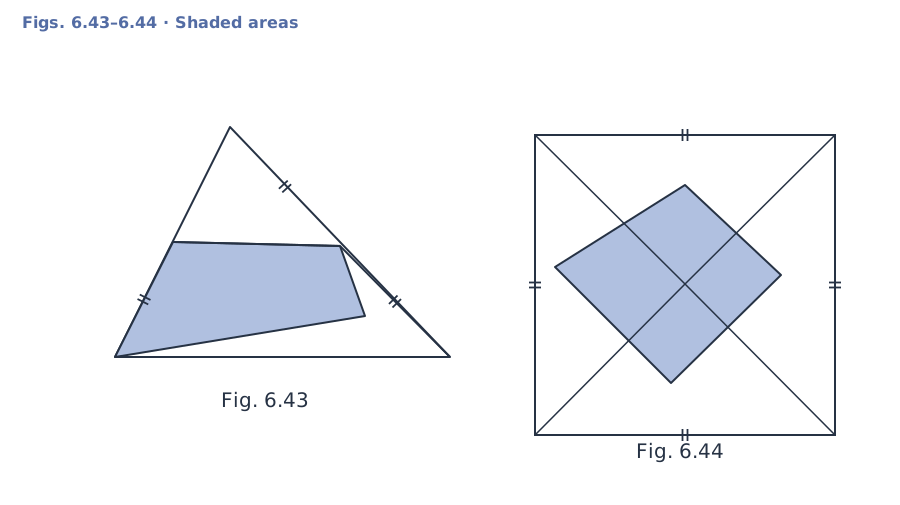
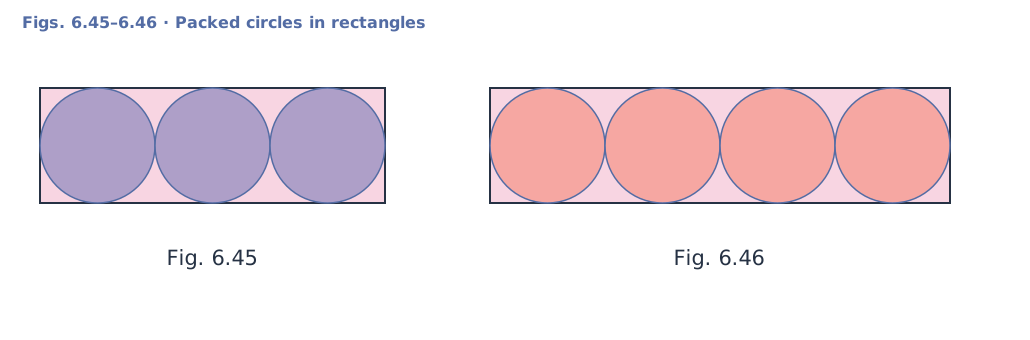
Figs. 6.43 and 6.44 - Using Fig. 6.45 and Fig. 6.46, determine what fraction of each rectangle is covered by the circles.
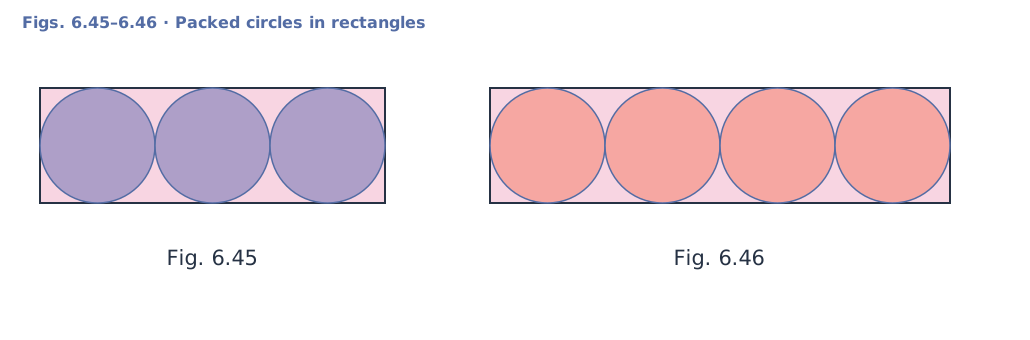
Figs. 6.45 and 6.46 - Use the above to make a conjecture about the area occupied by circles fitted into a rectangle in the manner shown. Test your conjecture for particular cases: 10 circles; 20 circles; 50 circles. Then prove your conjecture!
Figs. 6.45 and 6.46 - Fig. 6.47 shows nine identical rectangles fitted together to make a large rectangle whose area is 72 cm². Find the perimeter of each small rectangle.
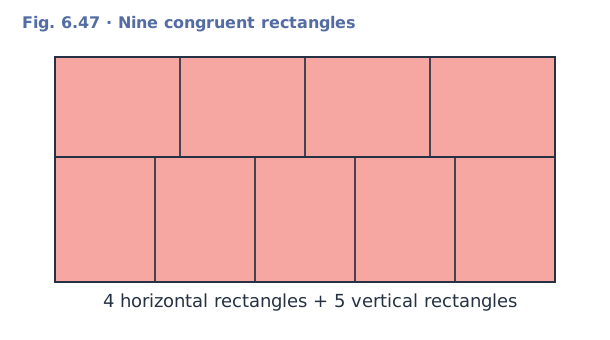
Fig. 6.47 - In Fig. 6.48, show that the areas of the shaded blue triangle and the shaded red triangle are equal. Find a way of cutting the blue triangle into pieces and rearranging the pieces to cover the red triangle.
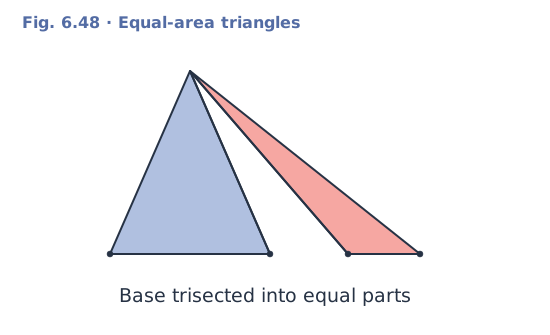
Fig. 6.48 - Fig. 6.49 shows a quarter circle in a square. Its centre is at one vertex, and it passes through two adjacent vertices. Two semicircles are drawn on two adjacent sides as diameters, creating shaded regions A and B. Show that A and B have equal area.
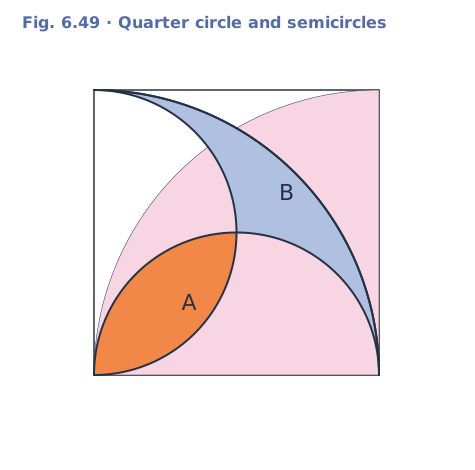
Fig. 6.49 - In Fig. 6.50, four semicircles are drawn within a square of side 2 units. Their centres are the midpoints of the sides, creating a four-petalled flower. Find the perimeter and area of the flower.
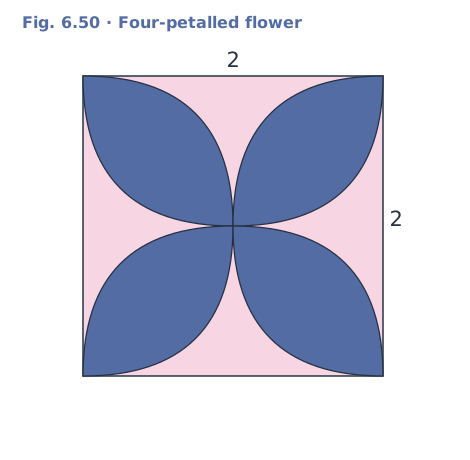
Fig. 6.50 - In Fig. 6.51, two concentric circles have common centre O. A chord BC of the larger circle touches the smaller circle at A, and BC = l. Show that the area of the region enclosed between the two circles is πl²/4.
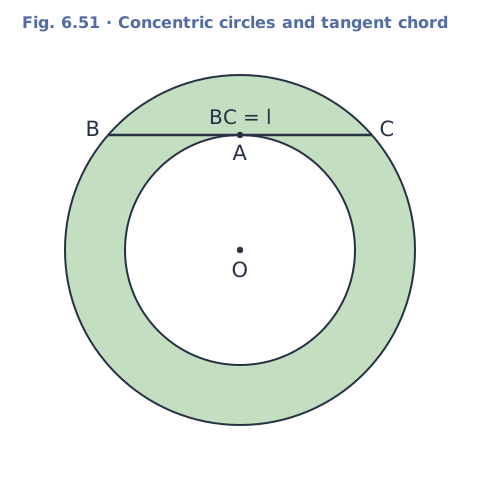
Fig. 6.51 - In Fig. 6.52, semicircles are drawn on all sides of a right-angled triangle. Show that Area(A) + Area(B) = Area(C).
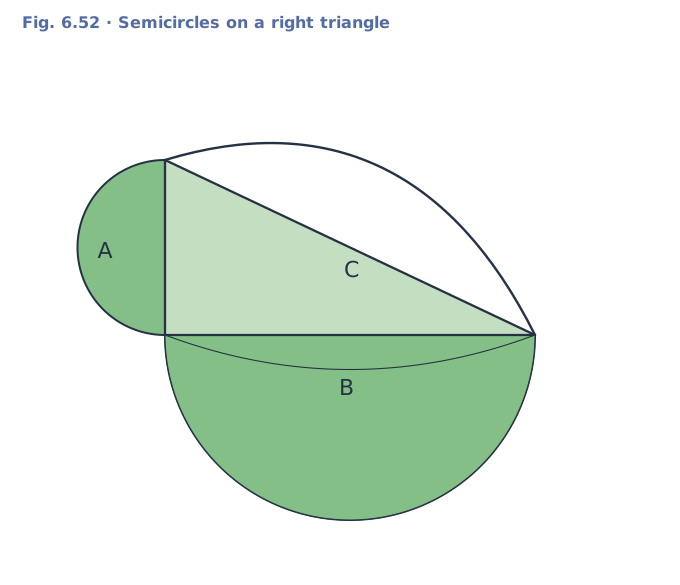
Fig. 6.52 - Fig. 6.53 shows two congruent circles passing through each other’s centres. Find the area of the region enclosed by the two circles in terms of the common radius r.
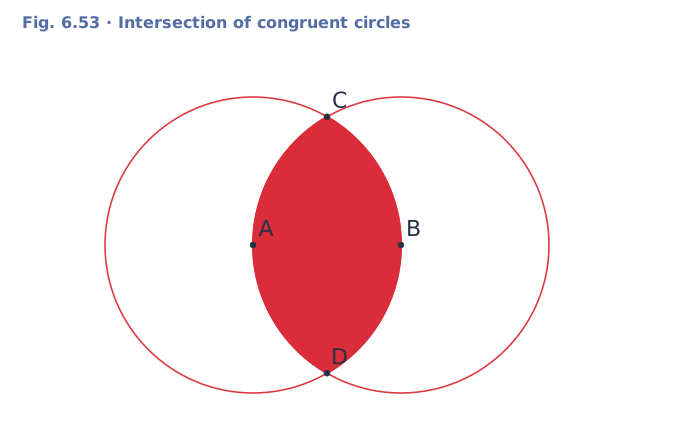
Fig. 6.53 - In Fig. 6.54, three triangles lie within a rectangle and have areas A, B and C as marked. Show that the area of the rectangle is 2(A + C)(B + C)/C.
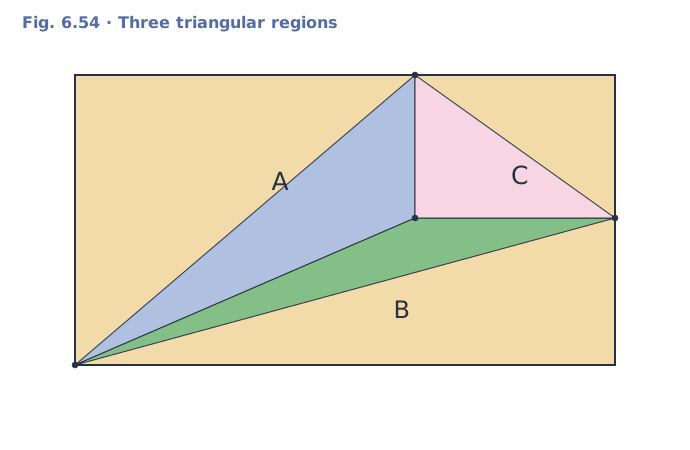
Fig. 6.54 - In Fig. 6.55, two shaded regions are formed by a quarter circle, a semicircle and a triangle. Show that the areas of the two shaded regions are equal.
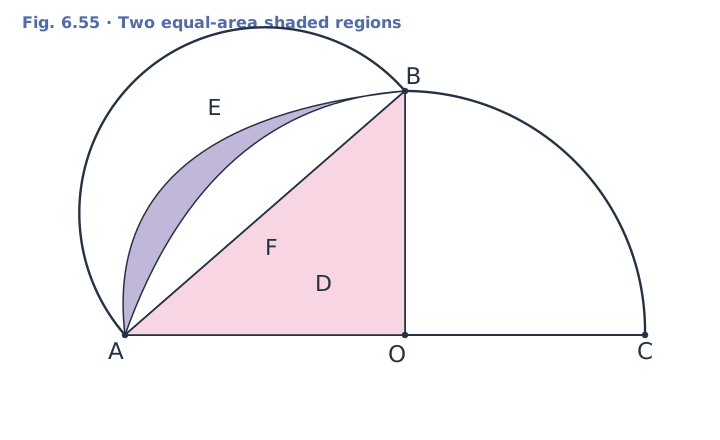
Fig. 6.55