Introduction to Linear Polynomials · NCERT Solved Problems
Exercise 2.EOC
End-of-Chapter Exercises
14 problems
- Write a polynomial of degree 3 in the variable x, in which the coefficient of the x² term is –7.
- Find the values of the following polynomials at the indicated values of the variables.
- (i)5x² – 3x + 7 if x = 1
- (ii)4t³ – t² + 6 if t = a 5 2
- If we multiply a number by 5/2 and add 2/3 to the product, we get −7/12. Find the number.
- A positive number is 5 times another number. If 21 is added to both the numbers, then one of the new numbers becomes twice the other new number. What are the numbers?
- If you have ₹800 and you save ₹250 every month, find the amount you have after
- (i)6 months
- (ii)2 years. Express this as a linear pattern.
- The digits of a two-digit number differ by 3. If the digits are interchanged, and the resulting number is added to the original number, we get 143. Find both the numbers.
- Draw the graph of the following equations, and identify their slopes and y-intercepts. Also, find the coordinates of the points where these lines cut the y-axis.
- (i)y = –3x + 4
- (ii)2y = 4x + 7
- (iii)5y = 6x – 10
- (iv)3y = 6x – 11 Are any of the lines parallel?
- If the temperature of a liquid can be measured in Kelvin units as x K and in Fahrenheit units as y °F, the relation between the two systems of measurement of temperature is given by the linear 9 equation y = 5 (x – 273) + 32.
- (i)Find the temperature of the liquid in Fahrenheit if the temperature of the liquid is 313 K.
- (ii)If the temperature is 158 °F, then find the temperature in Kelvin.
- The work done by a body on the application of a constant force is the product of the constant force and the distance travelled by the body in the direction of the force. Express this in the form of a linear equation in two variables (work w and distance d), and draw its graph by taking the constant force as 3 units. What is the work done when the distance travelled is 2 units? Verify it by plotting it on the graph.
- The graph of a linear polynomial p(x) passes through the points (1, 5) and (3, 11).
- (i)Find the polynomial p(x).
- (ii)Find the coordinates where the graph of p(x) cuts the axes.
- (iii)Draw the graph of p(x) and verify your answers.
- Let p(x) = ax + b and q(x) = cx + d be two linear polynomials such that:
- (i)p(0) = 5.
- (ii)The polynomial p(x) – q(x) cuts the x-axis at (3, 0).
- (iii)The sum p(x) + q(x) is equal to 6x + 4 for all real x. Find the polynomials p(x) and q(x).
- Look at the first three stages of a growing pattern of hexagons made using matchsticks. A new hexagon gets added at every stage which shares a side with the last hexagon of the previous stage. Stage 1 Stage 2 Stage 3
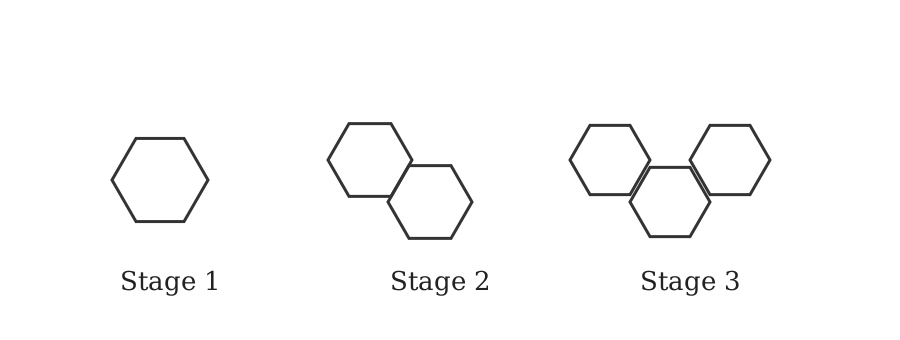
Matchstick hexagon pattern - (i)Draw the next two stages of the pattern. How many matchsticks will be required at these stages?
- (ii)Complete the following table. Stage 1 2 3 4 5 … n Number Number of matchsticks
- (iii)Find a rule to determine the number of matchsticks required for the nth stage.
- (iv)How many matchsticks will be required for the 15th stage of the pattern?
- (v)Can 200 matchsticks form a stage in this pattern? Justify your answer.
- Let p(x) = ax + b and q(x) = cx + d be two linear polynomials such that:
- (i)The graph of p(x) passes through the points (2, 3) and (6, 11).
- (ii)The graph of q(x) passes through the point (4, –1).
- (iii)The graph of q(x) is parallel to the graph of p(x). Find the polynomials p(x) and q(x). Also, find the coordinates of the point where these lines meet the x-axis.
- What do all linear functions of the form f(x) = ax + a, a > 0, have in common?