Triangles · Lesson 1 of 4
Triangles
“A right triangle is the only geometric shape that is literally never wrong.”
• Understand what similar figures are and recognise them visually. • Clearly distinguish similarity from congruence. • Identify corresponding vertices, sides and angles of similar figures. • Understand enlargement, reduction and scale factor. • Check whether two polygons satisfy the conditions for similarity.
Introduction
You have already met triangles, quadrilaterals, circles and many other shapes. You have also studied congruent figures—figures that have exactly the same shape and exactly the same size. But what happens when the shape stays the same while the size changes?
Imagine the same photograph printed once as a small passport photograph and once as a large poster. The poster is much bigger, but the person's face has not become wider, thinner or distorted. Every part has been enlarged in the same proportion. The two photographs therefore have the same shape even though their sizes are different.
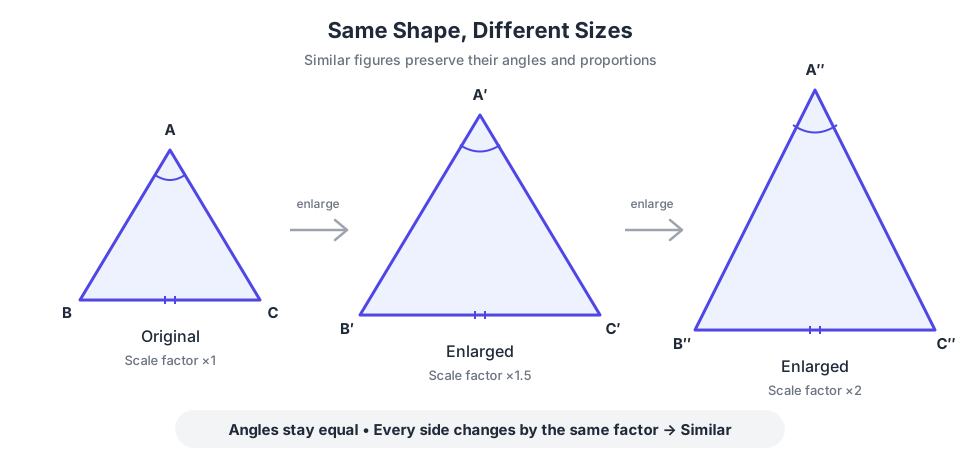
Two figures are called similar if they have the same shape, although their sizes may be different.
Similarity cares about shape, not absolute size. One figure may be larger or smaller, but it must not be stretched or distorted.
Why Is Similarity Useful?
Similarity allows us to work with objects that are too large, too small or too far away to measure conveniently. Instead of measuring the actual object, we can work with a smaller or larger figure having exactly the same shape and use proportions to calculate the unknown measurements.
| Where Similarity Appears | How It Helps |
|---|---|
| Maps | Large geographical distances are represented on a much smaller scale. |
| Building plans | A large building is represented using a small proportional drawing. |
| Models | Cars, buildings and machines can be represented as smaller versions. |
| Photographs | Images can be enlarged or reduced without changing their shape. |
| Indirect measurement | Heights and distances can sometimes be calculated without measuring them directly. |
Later in this chapter, triangle similarity will allow us to calculate things such as the height of a tower using shadows and proportions instead of measuring the tower directly.
Similar and Congruent Figures
Two figures are congruent when they have exactly the same shape and exactly the same size.
Similarity and congruence are related, but they are not identical ideas. Congruence is stricter: the figures must match perfectly in both shape and size. Similar figures need to preserve the shape, but their sizes are allowed to differ.

| Property | Similar Figures | Congruent Figures |
|---|---|---|
| Shape | Same | Same |
| Size | May be different | Must be exactly the same |
| Corresponding sides | Proportional | Equal |
| Scale factor | May be greater than, less than or equal to 1 | Exactly 1 |
| Example | Squares with sides 4 cm and 8 cm | Two squares each with side 4 cm |
Every pair of congruent figures is also similar because congruent figures already have the same shape. However, similar figures do not have to be congruent because their sizes may be different.
Problem
Square A has side 5 cm. Square B has side 10 cm. Square C also has side 5 cm. Compare Square A with B and then Square A with C.
- 1.Square A and Square B have exactly the same square shape.
- 2.Their sizes are different because their sides are 5 cm and 10 cm.
- 3.Therefore, A and B are similar but not congruent.
- 4.Square A and Square C both have the same square shape.
- 5.They also have exactly the same side length, 5 cm.
- 6.Therefore, A and C are congruent.
- 7.Since all congruent figures are also similar, A and C are both congruent and similar.
Which Figures Are Always Similar?
Take two circles with radii 2 cm and 20 cm. Their sizes are very different, but one circle is simply an enlarged version of the other. The circular shape does not change. Therefore, all circles are similar.
| Type of Figure | Always Similar? | Reason |
|---|---|---|
| Circles | Yes | Changing the radius changes only size, not shape |
| Squares | Yes | All angles remain 90° and every side scales equally |
| Equilateral triangles | Yes | All angles remain 60° and all sides scale equally |
| Rectangles | Not always | Their length-to-breadth ratios can be different |
| Isosceles triangles | Not always | Their angles and side proportions may differ |
Problem
Rectangle A measures 2 cm × 4 cm. Rectangle B measures 3 cm × 9 cm. Are they similar?
- 1.Both rectangles have four right angles.
- 2.Now compare their side proportions.
- 3.For Rectangle A, length : breadth = 4 : 2 = 2 : 1.
- 4.For Rectangle B, length : breadth = 9 : 3 = 3 : 1.
- 5.The proportions are different.
- 6.Therefore, the rectangles do not have exactly the same shape.
- 7.Hence, they are not similar.
Figures having the same name are not automatically similar. All squares are similar, but all rectangles, rhombuses, parallelograms or isosceles triangles are not necessarily similar.
Enlargement and Reduction
A figure remains similar when every length is enlarged or reduced by the same factor. If one side is doubled, every corresponding length must also double. If some lengths are doubled while others are tripled, the figure becomes distorted and is no longer similar to the original.
The common ratio between corresponding lengths of two similar figures is called the scale factor.
| Scale Factor k | Meaning |
|---|---|
| k > 1 | The new figure is an enlargement |
| 0 < k < 1 | The new figure is a reduction |
| k = 1 | The two figures have the same size |

Problem
A small rectangular drawing measures 6 cm by 4 cm. An enlarged copy measures 15 cm by 10 cm. Find the scale factor.
- 1.Compare corresponding lengths.
- 2.15/6 = 2.5.
- 3.Now check the other pair.
- 4.10/4 = 2.5.
- 5.Both dimensions have been multiplied by the same number.
- 6.Therefore, the scale factor is 2.5.
- 7.Since the scale factor is greater than 1, the second rectangle is an enlargement.
Problem
A rectangle measuring 4 cm × 6 cm is changed into a rectangle measuring 8 cm × 15 cm. Is the new rectangle a similar enlargement?
- 1.Compare the first pair of corresponding sides: 8/4 = 2.
- 2.Compare the second pair: 15/6 = 2.5.
- 3.The scale factors are different.
- 4.The figure has been stretched unequally.
- 5.Therefore, the new rectangle is distorted and is not similar to the original.
A true enlargement does not mean 'make everything bigger somehow'. It means multiply every corresponding length by exactly the same scale factor.
Corresponding Parts
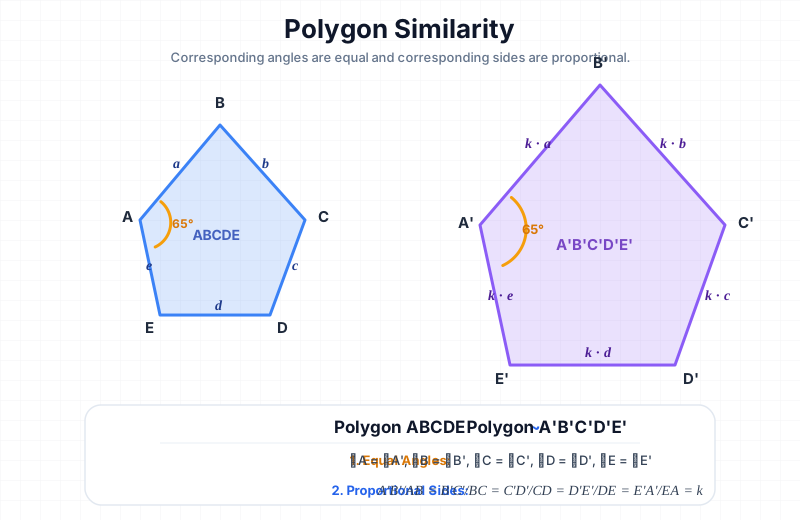
When two figures are similar, we need to know which corner, side and angle in one figure matches which part of the other. These matching parts are called corresponding parts.
Corresponding parts are the vertices, sides or angles that occupy the same relative position in two figures.

| First Figure | Corresponding Part in Second Figure |
|---|---|
| A | P |
| B | Q |
| C | R |
| D | S |
| AB | PQ |
| BC | QR |
| CD | RS |
| DA | SP |
Do not match sides only because they appear to be on the left, right, top or bottom of a drawing. A figure may be rotated or flipped. Correspondence depends on matching vertices and angles, not on where the figure happens to be drawn.
When Are Two Polygons Similar?
For circles and some regular shapes, similarity is easy to recognise. But for general polygons, simply looking alike is not enough. Mathematics gives us two precise conditions that must both be satisfied.
Two polygons having the same number of sides are similar if their corresponding angles are equal and their corresponding sides are in the same ratio.
For two general polygons to be similar, BOTH conditions are required: • Corresponding angles are equal. • Corresponding sides are proportional.
Problem
Quadrilateral ABCD has sides 3 cm, 5 cm, 4 cm and 6 cm. Quadrilateral PQRS has corresponding sides 6 cm, 10 cm, 8 cm and 12 cm. Their corresponding angles are equal. Are the quadrilaterals similar?
- 1.The corresponding angles are already given to be equal.
- 2.Now compare corresponding side lengths.
- 3.6/3 = 2.
- 4.10/5 = 2.
- 5.8/4 = 2.
- 6.12/6 = 2.
- 7.Every corresponding side has the same ratio.
- 8.Both similarity conditions are satisfied.
- 9.Therefore, the quadrilaterals are similar.
Are Equal Angles Alone Enough?
Consider a square and a long rectangle. Both have four angles of 90°. So their corresponding angles can all be equal. However, a square has equal length and breadth, while a long rectangle does not. Their corresponding sides therefore need not be proportional.
For general polygons, equal corresponding angles alone are not enough to prove similarity.
Are Proportional Sides Alone Enough?
Now compare a square with a slanted rhombus. Both may have all four sides equal, so their corresponding sides can be proportional. But the square has four right angles while the rhombus may have acute and obtuse angles. Their shapes are therefore different.
For general polygons, proportional corresponding sides alone are not enough to prove similarity.
For general polygons: equal angles + proportional corresponding sides = similar polygons. One condition by itself is not enough.
Can We Decide Similarity Just by Looking?
Drawings can be misleading. Two figures may look almost identical but still have slightly different side proportions or angles. In geometry, a diagram helps us understand the problem, but mathematical measurements and properties provide the actual evidence.
Never write 'the figures look similar, therefore they are similar' as a mathematical reason. Use angle equality, proportional sides or another proven geometric property.
A Simple Similarity Checklist
| Step | What to Check |
|---|---|
| 1 | Do the figures have the same number of sides? |
| 2 | Identify which vertices and sides correspond. |
| 3 | Check whether corresponding angles are equal. |
| 4 | Check whether corresponding sides have the same ratio. |
| 5 | If both conditions hold, the polygons are similar. |
• Confusing similar figures with congruent figures. • Thinking similar figures must have exactly the same size. • Assuming every pair of rectangles is similar. • Assuming figures of the same type must always be similar. • Comparing sides that do not correspond. • Checking only the angles of general polygons. • Checking only the side ratios of general polygons. • Deciding similarity only from the appearance of a diagram. • Forgetting that every length must change by the same scale factor.
Quiz
What best describes two similar figures?
Which statement is always true?
Which type of figures is always similar?
What is required for two general polygons to be similar?
A 6 cm segment becomes 15 cm after enlargement. What is the scale factor?
Two rectangles already have equal corresponding angles. When are they similar?
Practice Problems
- Fill in the blank: All circles are ________ to one another. (similar / congruent)
- Fill in the blank: All ________ triangles are similar to one another. (isosceles / equilateral)
- Complete the statement: Two polygons having the same number of sides are similar when their corresponding angles are ________ and their corresponding sides are ________.
- Give two different examples of pairs of similar figures.
- Give two different examples of pairs of figures that are not similar.
- A square has side 6 cm and another square has side 15 cm. Are they similar? Are they congruent? Give reasons.
- Rectangle A measures 4 cm × 10 cm and Rectangle B measures 6 cm × 15 cm. Check whether the rectangles are similar.
- Rectangle P measures 5 cm × 8 cm and Rectangle Q measures 10 cm × 18 cm. Check whether the rectangles are similar.
- Two quadrilaterals have equal corresponding angles. The sides of the first are 3 cm, 4 cm, 5 cm and 7 cm. The corresponding sides of the second are 6 cm, 8 cm, 10 cm and 14 cm. Determine whether the quadrilaterals are similar.
- A square and a rhombus have corresponding side lengths in the same ratio. Can this information alone prove that the two quadrilaterals are similar? Explain your answer.
Key Takeaways
• Similar figures have the same shape but may have different sizes. • Congruent figures have both the same shape and the same size. • Every pair of congruent figures is similar, but similar figures need not be congruent. • Enlargement or reduction preserves similarity only when every corresponding length changes by the same scale factor. • Corresponding parts are matching vertices, angles and sides in two figures. • All circles, all squares and all equilateral triangles are respectively similar. • General polygons are similar only when corresponding angles are equal AND corresponding sides are proportional. • Equal angles alone or proportional sides alone are not sufficient for similarity of general polygons.
Previous
Start of chapter
Next · Lesson 2
Similarity of Triangles